
SustainabilityInitiatives Regarding the Recommendations of the Task Force on Climate-related Financial Disclosures (TCFD)
We will strengthen our efforts to address climate-related management issues in accordance with the recommendations of the Task Force on Climate-related Financial Disclosures (TCFD), established by the Financial Stability Board (FSB), regarding the risks and opportunities that climate change poses to our business, and we will strive to enhance our disclosure practices.
Governance Structure
The "Risk Management Committee," chaired by the President and CEO and comprising full-time directors, executive officers, and heads of each department at headquarters, meets once every three months to discuss and address sustainability issues, including climate-related risks and opportunities. Additionally, starting in fiscal year 2022, we have been reporting sustainability issues—including climate-related risks and opportunities—to the Board of Directors and overseeing the review and response to these issues.
Strategy
Utilizing the TCFD recommendations framework, we have identified the following risks related to how climate change will impact our business over the medium to long term. We will proceed to quantify the impact on our business and further explore specific measures.
| Category | Item | Anticipated Risks | Risk Assessment |
|---|---|---|---|
| Transition Risk | Carbon Pricing |
|
High |
| Reputation |
|
High | |
| Physical Risks | Rise in average temperature |
|
Small |
| More severe extreme weather events |
|
Medium |
Risk Management
The Risk Management Committee comprehensively identifies and manages risks across the entire Group, including those related to climate change. The Committee solicits reports from each department to identify all business-related risks. After assessing the potential impact on the company should these risks materialize, the Committee formulates countermeasures and reviews existing ones to ensure they deliver results.
Tracking CO2 Emissions and Future Policy
We believe that contributing to the advancement of a smart society and a decarbonized society through our business operations leads to risk reduction. Therefore, we began tracking Scope 1 and Scope 2 CO2 emissions—those resulting from our business activities—in 2021.
Regarding Scope 3, we predict that, given our business model, CO2 emissions resulting from the use of products we sell (Scope 3 Category 11) have the greatest impact on climate change. We are working to track these emissions and aim to reduce our environmental impact by developing more energy-efficient equipment.
Our goal is to reduce CO2 emissions (Scope 1 and Scope 2) compared to the previous fiscal year’s results.
| Item | FY 2021 | FY 2022 | FY 2023 | FY 2024 | FY 2025 | |
|---|---|---|---|---|---|---|
| Scope 1 | Group | 13.5 | 13.9 | 6.3 | 11.5 | 12.5 |
| Non-consolidated | (N/A) | (N/A) | (N/A) | (N/A) | (N/A) | |
| Scope 2 | Group | 15,405.6 | 15,186.3 | 15,343.1 | 9,734.9 | 12,168.7 |
| Non-consolidated | 880.5 | 1,270.9 | 1,398.7 | 1,510.9 | 1,518.1 | |
| Scope 3 (Category 11) | Group | Not calculated | 60,722.0 | 48,678.0 | 53,347.3 | 56,223.5 |
- *For Scope 3 (Category 11), we used actual measured values for equipment where CO2 emissions could be measured, and calculated values based on the maximum values listed in the specifications for equipment where actual measurements were not available. These calculations cover 90% of all units sold by our company. Additionally, the calculations are based on annual emissions assuming the equipment operates for 15 hours per day, 300 days per year.For some units where the maximum value listed in the specifications is unknown, figures from similar units have been used.
- *Regarding Scope 3, given the nature of our business, emissions from the equipment we sell are considered to account for the largest proportion of total Scope 3 emissions; therefore, we are disclosing data only for Category 11.
Our Initiatives
Measurement of CO2 Emissions
As a research and development hub, we aim to reduce CO2 emissions by cutting power consumption through initiatives such as equipment design aimed at improving efficiency in terms of output or results per unit of power consumed. Specifically, this includes reducing power consumption by increasing the area of the equipment’s film deposition process, shortening processing times, improving yield rates, and replacing widely used diffusion pumps (DP) with energy-efficient turbo molecular pumps (TMP).
Energy-Saving Examples
Solutions for Oil Diffusion Pumps (DP)
- ①Optimization of the Heating System:
By introducing PID control to maintain a constant heating temperature for the DP, we can reduce the DP’s power consumption in 1800-size deposition systems. - ②Replacement with a turbo molecular pump (TMP):
We have developed a deposition system that replaces the widely used DP with a TMP, which offers the same pumping capacity while consuming less power. When equipped with a TMP, power consumption related to the pump can be reduced in 1800-size deposition systems compared to models equipped with a DP.
Measurement of CO2 Emissions
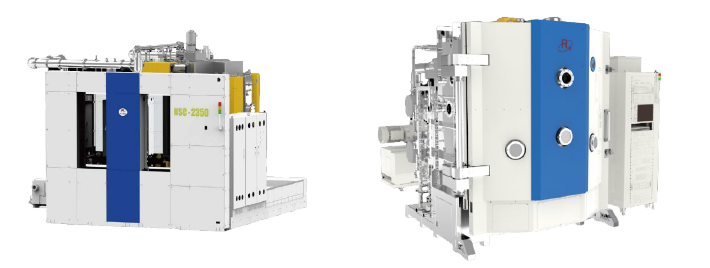
To reduce CO2 emissions, we have begun measuring the CO2 emissions of our equipment on a rolling basis.
Examples of equipment for which CO2 emissions measurement has begun
NSC2350OTFC1800(TMP)
Introduction of LED Light Bulbs
We have introduced LED light bulbs in our headquarters building and are striving to achieve energy savings and CO2 reductions.
Our Group’s Initiatives
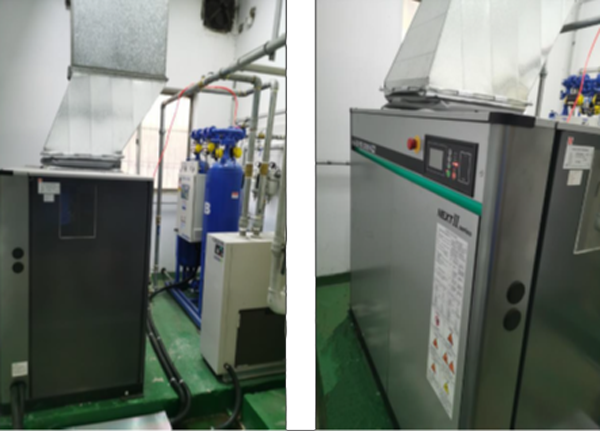
(Initiatives at Optran Shanghai)
By replacing fixed-frequency air compressors with inverter-type units, we have achieved energy savings and CO2 reductions.
We are also striving to achieve energy savings and CO2 reductions through the use of solar power generation and heat recovery systems for hot water supply.
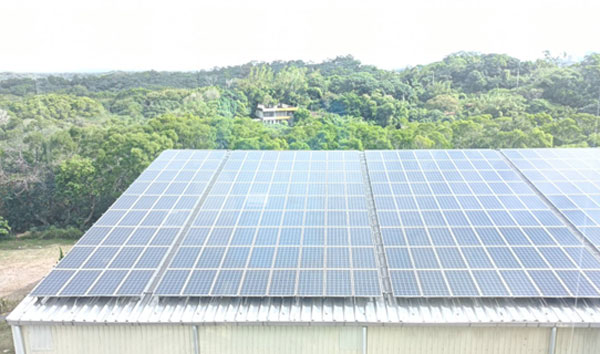
(Optran Taiwan's Initiatives)
We are achieving energy savings and CO2 reductions through solar power generation.
(Initiatives at Kōchi Semiconductor Technology)
We are striving to achieve energy savings and CO2 reductions through the use of solar power generation and thermal systems for hot water supply, among other measures.